
The return of the Albanese government with an overwhelming majority signals a renewed push on the energy transition, with discussion already occurring around more ambitious targets.
The further penetration of renewables and the planned exit of coal generation from the NEM will see ongoing intermittency and variability in supply. Transitions are never easy, and Australia is about to hit the bumpiest part.
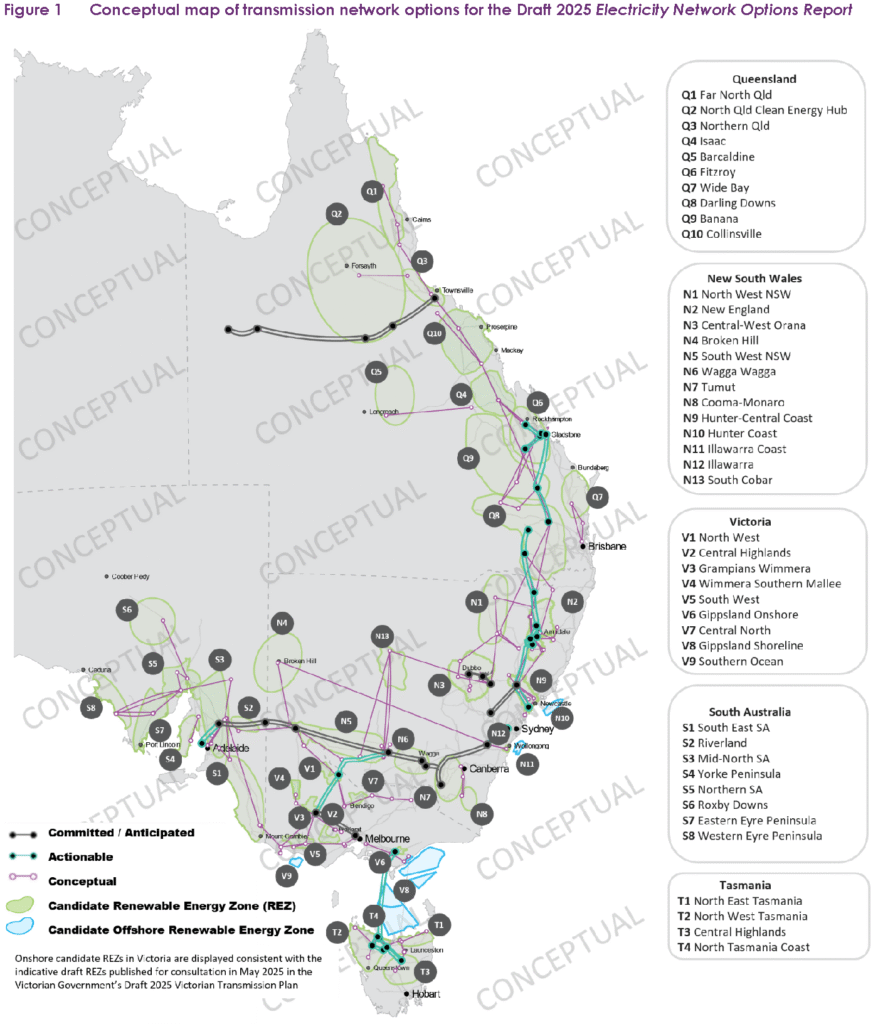
In preparation for its next iteration of the Integrated System Plan (ISP), AEMO recently published its draft 2025 Electricity Network Options Report. One look at the conceptual map is enough to grasp the challenge: more assets, more connections, more urgency, and more data requirements than ever before.
What’s Changing?
Distributors, once data-lite compared to developers, are playing catch-up with the infrastructure developers in terms of data requirements, aiming to bring generation online faster and faster, connecting in ways and places that they have never been before.
We will start to see the system require more and more data as consumer energy resources (CERs) and other distributed resources integrate more and more into the system. On top of that, we have a shared state and federal plan to bring 1.2 million new homes into the grid by 2029.
Costs are increasing (the report says 25-55% increase on cots for overhead lines), supply chain pressures remain, workforce shortages are unabated, and projects are becoming more complex as Australia moves on from the first phase of projects.
And what happens when big projects get harder, faster, and bigger? Good reporting becomes a non-negotiable. And good reporting requires a quality data strategy, regimen and team.
Ignite’s predictions for Data Teams in FY26
Increased reporting granularity, accuracy and speed
Business leaders will need increasing granularity, accuracy and speed in their data reporting. They will want real time analysis of the impact of the transition in their portfolio as they seek to optimise returns.
Increased customer transaction data and reporting
Changes with how you transact with your customers will require more detailed reporting and more data sources ingested into your platform – PPAs, behind-the-meter innovation, VPPs and other new options such as EVs as surrogate household battery.
Changes to business counterpart contracting
Changes with the way that your business teams contract with counterparties – various clauses within PPAs top optimise supply and demand algorithms, customer contracts that are linked to assets and real time matching, LGCs, ACCUs and REGOs in 2030 as well as new measures that may be introduced as resulting from the NEM Review.
Increased granularity in government engagement
There will be a greater degree of granularity in your government engagement (federal and state) – programs like the CIS will require generators to be able to understand when they hit cap and collar periods and record and manage their obligations within this scheme. There is likely to be more programs that will be deeply dependent upon various data to be shared, new programs and state-based nuances. On top of that, more departments will become increasingly involved in the transition – energy, climate, water, planning, heritage, manufacturing, industry, state development, telecommunications (data centres), trade (green exports) and more. And they will all be hungry for data.
Regulators will require more insight
The increasing penetration of smart meters, ongoing cost of living pressures and requirements to provide data and insights to regulatory authorities. The current NEM Review will likely make recommendations that will require more data driven solutions, as well as may require retailers to provide new reporting capabilities.
Renewable focused derivatives will replace traditional hedge instruments
Changes in the fundamental structure of the merchant market – traditional hedge instruments like caps will be replaced with new renewable focused derivatives that may include global solutions and interactions with new and different counterparties. These will require new and varied data inputs, outputs, rules and reporting.
Wholesale re-shape of the structure of load within the NEM
The advent of new green economies like Green Data, Green Hydrogen, Green Iron and Green Fuels will see load develop in new locations, each with all new data needs and reporting requirements.
Forecasting will require more data, capability and analysts
How you forecast the future – the ability to ingest and use multiple forward curves and future scenarios into your business’ planning cycles – means more data and more data capability and more analysts.
AI pressure will continue to mount
You will face repeated requests from your business leaders to ‘embrace AI’ with limited understanding or readiness across your business. Teams that have to learn to use new platforms and programs and an ongoing shortage of capabilities and skills.
In this environment, who you choose to partner with will be more important than ever. Success won’t come from throwing more tools at the problem.
Taking the time to truly define your data strategy that aligns with the business’s goals and future state will be the difference between those that flounder and those that flourish during that transition.