
Most organisations right now are asking: Which AI tool should we use?
It’s the wrong question.
What they should be asking is: “Where does advantage actually come from?”
The Commoditisation Problem Nobody’s Talking About
Here’s the uncomfortable truth about the current AI gold rush.
When your competitors use:
- the same models
- the same external data
- and the same optimisation tools
They start making the same decisions.
Similar pricing. Similar customer experience. Similar risk behaviour.
The biggest risk of AI isn’t falling behind. It’s about removing the differences between you and your competitors.
AI, applied carelessly, doesn’t create competitive advantage. It erodes it. Data Is the Variable. Not the Model.
If everyone trains on shared data, outcomes are generic. If everyone feeds the same external inputs into the same large language models, the outputs converge. Shared models applied to shared data produce shared outcomes.
The question worth asking is this:
“What data do we have that a new entrant to our market can’t download from the internet?“
That’s where advantage lives. In operational data, the knowledge locked inside your systems. Years of decisions, transactions, customer behaviour, operational patterns; the things that competitors can’t replicate.
So, before picking out a shiny new AI tool, think about what you have and the strategy you need to adopt to realise an advantage.
Choosing Your AI Strategy
There are four places most organisations land on AI strategy:
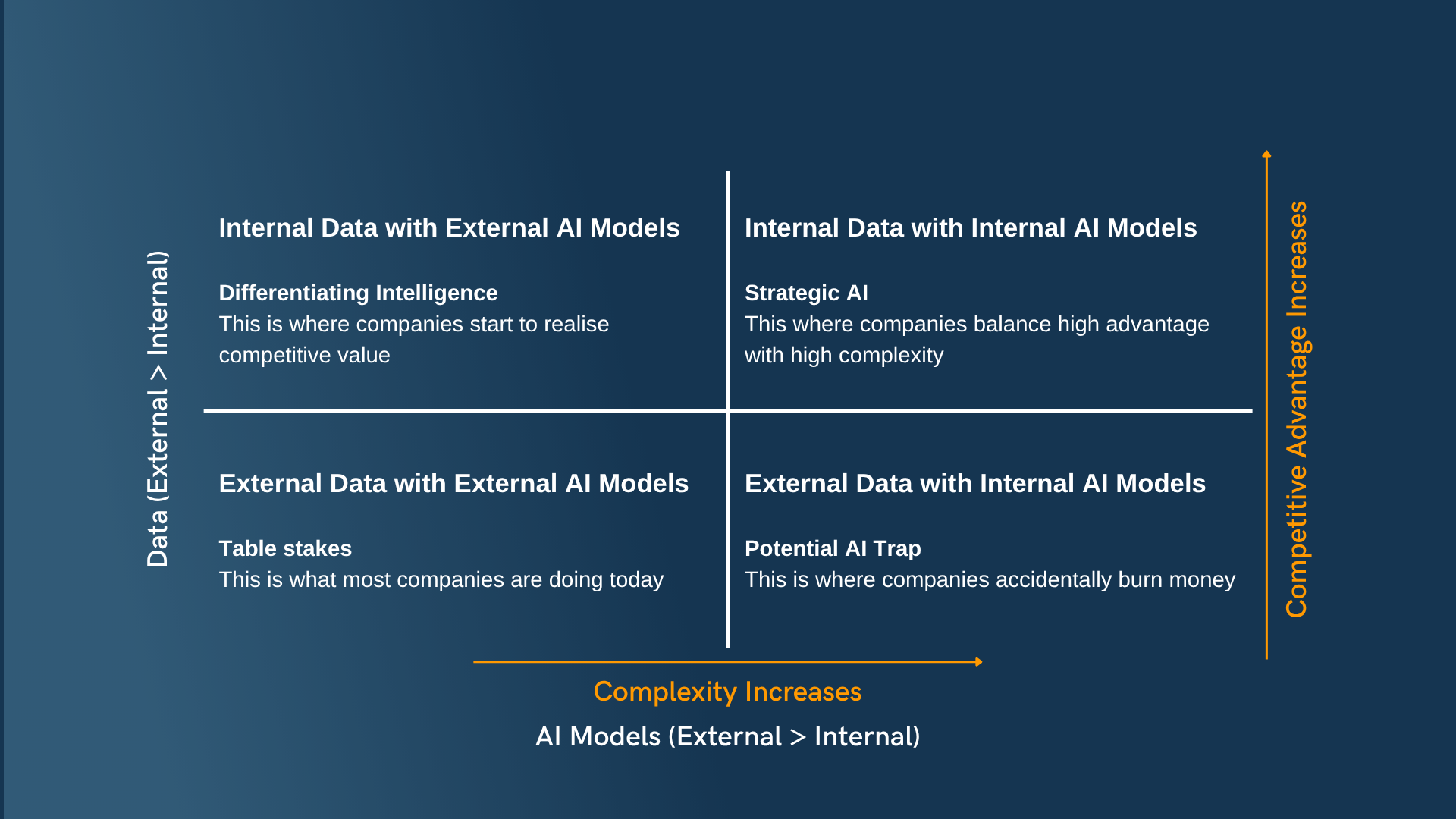
External Data + External AI Models
Table stakes. Your staff are already using ChatGPT, Copilot, and Gemini. This isn’t something to stop. It’s something to guide. Focus on guardrails, safe usage, and education.
Internal Data + External AI Models
Whilst useful, safe and low friction, it mostly touches documents, emails, and collaboration data (i.e. Copilot over SharePoint, AI search, document summarisation). It rarely reaches operational systems – so it tends to improve productivity not business performance.
To reach operational data, many organisations adopt AI-first platforms (e.g. modern billing engines like Kraken). Whilst these are powerful, they are trained on shared industry data, built on shared models, deliver shared operating logic. Efficient, yes. But differentiated?
External Data + Internal AI Models
This can be a trap. IT teams build AI infrastructure, agent frameworks, and model endpoints in pursuit of transformation. Without a proprietary data strategy, this becomes infrastructure looking for a problem. High complexity. Low differentiation.
Internal Data + Internal AI Models
This is where true advantage sits. Forecasting, optimisation, predictive decisions built on knowledge your competitors can’t access. Most organisations try to jump here first, before their operational data is accessible, understood, or historically deep enough to be useful. The sequencing matters enormously.
Where to Actually Start
Not with a tool. Not with a vendor. Not with a transformation programme.
Start with a question:
“What operational knowledge exists in our systems that competitors cannot access?”
Answer that honestly, and your AI strategy writes itself.
This is the executive briefing we’ve been running with leadership teams on AI, data, and competitive advantage. If it’s a conversation worth having in your organisation, get in touch.
This is the executive briefing we’ve been running with leadership teams on AI, data, and competitive advantage.
If it’s a conversation worth having in your organisation, get in touch.